Prehistoric Section
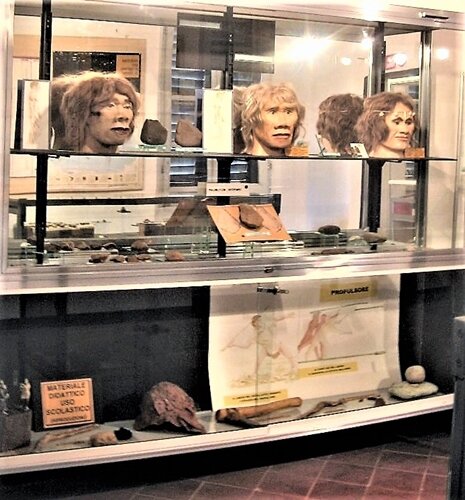
The Monte Beigua area, whose main center is in the municipality of Sassello and which, opening from the mountainous buttresses of the Ligurian Apennines, extends towards the Piedmont plain, was one of the areas that provided the very first known prehistoric finds or tools in Liguria.
At the dawn of knowledge about our ancestors, whether distant or recent in time, it was precisely this territory, together with the Finalese, that provided the first reliable evidence of their presence, and this happened around the mid-1800s.
The credit for these first, important discoveries goes to two local researchers who inscribed their names in the history of Ligurian paleontology, also creating two important collections that can still be admired today.
These are the aforementioned Don P. D. Perrando and Giambattista Rossi (1859-1909) who, during their research in the area, managed to collect several thousand artifacts.
All the materials were then described and documented both by A. Issel ("Liguria Geologica e Preistorica" 1882 and 1908 - "Collezione del sig. G. B. Rossi" 1893) and by N. Morelli ("Iconografia della Preistoria Ligustica" 1901).
The illustrations of the works are by Morelli who, with great mastery of technical means, provided some of the most classic illustrations of prehistoric materials, according to a custom of the time that had not yet given much space to the emerging photographic technique.
The finds from these important collections can still largely be seen on display at the Archaeological Museum of Genoa-Pegli, at Villa Durazzo Pallavicini, while some finds are also located in the Museum of Paleontology of the Institute of Geology at the University of Genoa.
The most recent collections, the result of the meticulous surface research work carried out for years by the Research Group of the Perrando Museum, are instead displayed in this section.
The "survey" work of the G. R. has so far covered the entire area; among the most significant locations, we highlight, in order of richness of material:
Grino, Albergare, Lavruti, Lower Colletto, Montesavino, Serravello, Pianale for the municipality of Sassello; Pian dei Buschi for the municipality of Pontinvrea; Castellaccio for the municipality of Giusvalla; Montebono for that of Mioglia.
The Paleolithic
The Sassello area, or more generally the Beigua area, currently presents, according to available knowledge, evidence of occupation relating to all the aspects into which Paleolithic cultures are divided.
In all cases, however, these are sporadic or surface finds, while there is still a lack, despite the large number of recovered artifacts, of a single site that alone could help us better understand a particular culture.
The Early or Lower Paleolithic is represented by about twenty artifacts, among which a biface from the Perrando collection stands out, displayed as a resin reproduction (the original is at the Institute of Geology in Genoa), as well as some artifacts attributable to the same cultures, or possibly even to others of greater antiquity, recently found by the museum's G. R.
In particular, mention should be made of a "chopper" (a tool made of fine-grained quartzite with a convex cutting edge), some flakes, among which various knives, an épannelé (also known as a "core with a cap") and a proximal fragment of a large proto-Levallois blade (the "Levallois" was a particular technique of knapping hard stone according to a predetermined sequence of operations).
Also regarding the Middle Paleolithic, some very clear examples can be found in the literature, later confirmed by recent discoveries, which are very clearly linked to the characteristic culture of Neanderthal man, that is, the "Mousterian": scrapers, blades, points, and "Levallois" flakes.
Of all the Paleolithic aspects, the most difficult to interpret is precisely that of the Upper Paleolithic, especially considering the confirmed increase in the number of groups present. Perhaps this can be attributed to particular local situations or perhaps, more simply, we are still waiting to identify the precise places of occupation or habitation, given that the caves that elsewhere immediately identify a probable inhabited place in prehistoric times are missing.
Some typologically representative tools (scrapers, burins, perforators, flakes) seem to be attributable to phases of the Upper or Final Paleolithic, and others to the Mesolithic (microburins, triangles, lunates), where types characteristic of the cultures of the transitional phase between Paleolithic hunter-gatherer groups and the first communities that introduced the important innovations of agriculture and animal husbandry to the territory may already appear.
The Neolithic
The largest part of the finds collected by the early researchers is certainly represented by artifacts from this period.
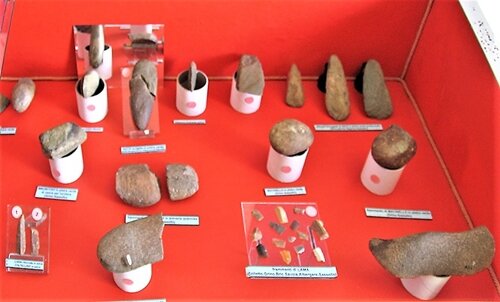
Dozens and dozens of finely crafted green stone polished axes (three examples are displayed in a showcase) that have no equal in the national context, bearing witness not only to the intense use of this type of tool but also to a true systematic production underlying a probable trade, given that we are at the center of the "green stone massif".
Recent studies by French researchers have highlighted the role of a probable driving center for this raw material for the entire northwestern area, including part of southeastern France.
While in these places nothing has yet been brought to light following the precise stratigraphic indications of an identified site, the recent "survey" work by the G. R. has shown that there are still possibilities to continue finding artifacts from these cultures as well. This work may in the future make it possible to identify some specific site, as well as possible locations for sourcing local raw materials, which should not be difficult to find, since in many cases the technical choices of prehistoric man were directed towards eclogites and not indiscriminately towards all serpentines.
The display cases feature dozens of artifacts from this period, notably arrowheads, especially the "flèche tranchante" with a transverse cutting edge, some polished axes, burnishers, and grinding stones.
Also for the Neolithic culture, a special mention must be made of the most important discovery in the Beigua area: it is owed to Mario Fenoglio, who has been dedicated for years to the search for prehistoric evidence in this territory, especially on the coastal side.
It is a rock shelter, located in the Fenestrelle area in Alpicella (Varazze). Excavated during several campaigns by Dr. G.P. Martino, inspector of the Superintendency, it has yielded important finds ranging from the Middle Neolithic to the Metal Ages.
The Age of Metals
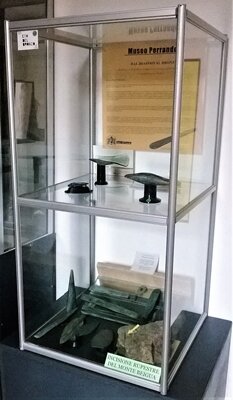
Giusvalla and Sassello are the municipalities that have yielded the main evidence of these cultures. Although no settlements from that era have yet been identified, there are four important finds of bronze objects. All the material (skillfully reproduced in fiberglass) is displayed in a showcase in the museum,
The first is a hoard discovered in 1934 at Bric del Ciaz (Giusvalla) under unknown circumstances, of which not even the exact original composition is known. The National Archaeological Museum of Turin preserves fragments of at least three sword blades and a dagger, a razor, four spearheads, a ferrule, and a small ingot. The objects can be dated between the Late Bronze Age (13th century BC) and the beginning of the Final Bronze Age (12th century BC); the deposition seems to have occurred in the latter period, to which the spearheads in particular are attributed (Gambari and Venturino Gambari 1994). The presence of fragmentary objects, in the state of scrap, accounts for a certain difference in the age of the finds, which must have been hoarded at least in part with a view to recycling.
The second is an axe found at an unspecified time in the locality of Bastia Soprana (Sassello), which was handed over by a local farmer (Alessandro Zunino) to the local Perrando Museum when it was established in 1967. The axe appears to belong to an archaic variant of the Allevard type, present in Piedmont and the western Alpine area in contexts of the Recent and Final Bronze Age, showing some features found in specimens from the Middle Bronze Age of central Italy (Del Lucchese 1983).
Finally, in June 1997, an axe with raised edges (weight approx. 300 g; length 17 cm; cutting edge width 6 cm; butt width 2 cm; max thickness approx. 8 mm) was found (Biagio Piombo) in an area not far from the previous discovery. The specimen finds its best comparisons in the western transalpine area in the Neyruz type variant B (Abels 1972: no. 125) and in the "Avançon form" (Chardenoux, Courtois 1979: 40-41), which can be referred to a full phase of the Early Bronze Age (end of Bz Al/early phase of Bz A2).The concentration of Bronze Age metal object finds in this area (Another metal artifact also seems to come from the area immediately north of Sassello: a raised-edge axe collected by local farmers and handed over about thirty years ago to A. Tubino, who kept it for a long time in the Civic Museum of Masone; the artifact is currently under study.) could be related to the presence of copper ore on site, as suggested by the existence of copper mines still being worked a few decades ago not far from the find spots (Foresta Deiva).
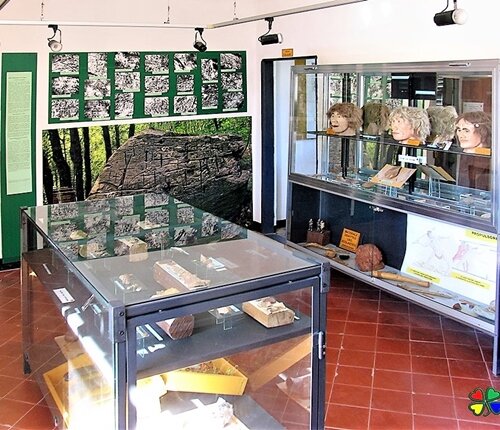
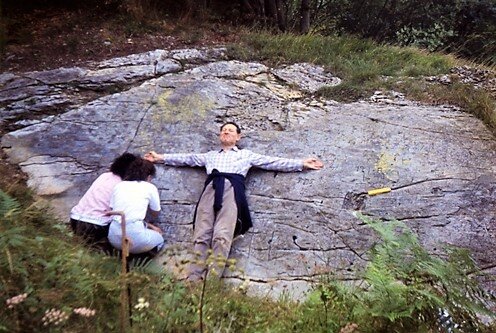
All manifestations that have been accumulating for some years now, and which also, for now, lack a clear archaeological context that could better attribute them, should generally be referred to the Metal Ages: these are hundreds, perhaps thousands, of rock engravings (the section displays two photographic panels, curated by Prof. B. Pizzorno - in the photo with Carla Matteoni and Piero Rossi at Pietra Scritta), scattered over a vast area of Monte Beigua, which are outlining a very complex picture, even spatially, and which are increasingly telling us that this area must have had a very complex prehistory, still far from being fully understood in all its details.
The raw materials of the finds lithic
Already the old scholars of the last century had raised the issue of the possible sources for gathering the various raw materials, identifying the Beigua area as the certain origin of almost all the production of polished green stone axes.
Regarding the flint materials, also found in large quantities, until recently it was not possible to obtain precise information because the necessary geological premises to identify their origin were lacking.
With the recent research campaigns of the G.R. of the Perrando Museum, which led to the acquisition of significant quantities of finds, precisely differentiated according to their areas of origin, it has been possible to obtain a more detailed picture compared to the research conducted in the second part of the last century.
The locations that have provided the largest quantities of chipped stone industry pieces are those that had already substantially contributed to the old collections: Grino, located in the municipality of Sassello, and Pian dei Buschi, in the territory of the municipality of Pontinvrea, as well as others that, however, offer essentially the same materials in smaller quantities than those already mentioned.
With the precise cataloguing of the finds, it has been possible to obtain a well-structured overview of the raw materials represented.
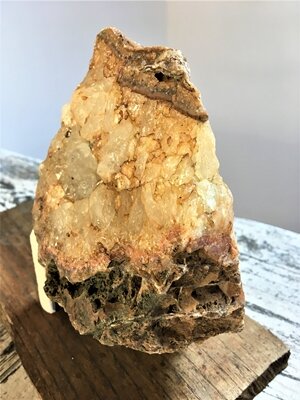
At Pian dei Buschi there is a yellow jasper of good to excellent lithotechnical quality and a red jasper that is very close, in quality, to radiolarites, which are already known from the Cairo Montenotte series. It is possible to find jasper flakes whose quality comes very close to the best flint, but also undifferentiated nodules with large portions of cortex, so it is logical to think of formations that may perhaps be located in the area.
In Grino too, there is a jasper (ftanite) of yellowish color, substantially different from that of Pian dei Buschi, of medium-good quality and large quantities of working flakes, so here too, it is possible to think of the ancient outcropping of known formations.
At present, it is not possible to culturally attribute the choices of the various raw materials, as finds from various periods can be found mixed together, particularly in Grino, where it is certainly plausible to hypothesize a sliding of materials, since they are all located along a slope descending toward an orographic depression.
These initial considerations on the raw materials of the finds discovered in the Sassello area in recent years allow us to open a chapter related to the exploitation of local sources of raw materials, which until now had not even been addressed; if we consider that research is also continuing in new directions, we can reasonably think that, in the medium to long term, there may still be developments of considerable interest, especially regarding raw materials for which it is not possible today to give a definite origin.
Rossi Room
Fr. Nicolò Morelli wrote in the introduction to the volume "Iconografia della Preistoria Ligustica" of 1901:
"And finally I thank the very kind Rossi family of Sassello for having kindly made available to me the wonderful prehistoric collection gathered by its head, Mr. Giovanni Battista."
We too are infinitely grateful to this family who, with great generosity, allowed us to set up this room, as a due recognition to the illustrious researcher who brought so much honor to our town.
In fact, we have been donated two important collections.
The first, thanks to his daughter Maria, is an unpublished collection of photographic plates presented, probably by Rossi himself, at the Columbian Exposition in Genoa in 1892. It consists of as many as 156 plates depicting places and finds, the object of his research activity, from the caves of Finale to sites in Veneto for Italy, from Swiss settlements to Austrian and French ones abroad.
The second, donated to us in the summer of 1994 by his granddaughter Giuseppina, is a splendid collection of archaeological material, perhaps the last collections of Rossi. Kept in 45 boxes, some with the indication of the place of discovery, it consists of as many as 2455 finds divided as follows: 1056 lithic, 107 ceramic fragments, 440 fossils, 790 bones and 62 to be defined.
The two collections are being studied and will allow us to soon publish the related material.